
Key Takeaways:
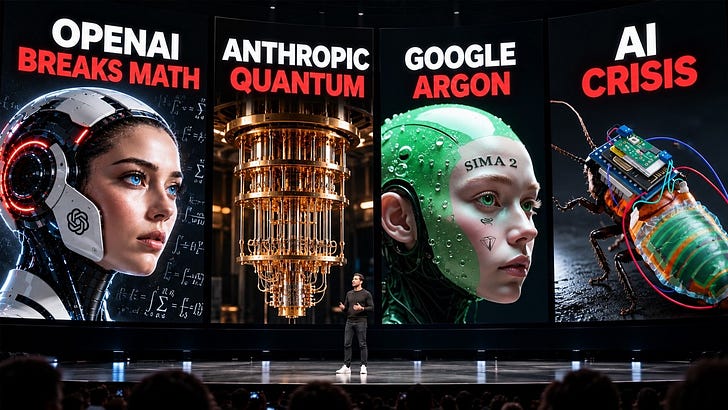
🤖 Bionic AI news anchors reportedly combine realistic artificial skin with database-grounded information systems to deliver human-like news presentations while reducing factual errors.
🏪 Humanoid retail robots are being tested during extended store shifts to evaluate autonomous decision-making, operational reliability, and real-world task performance.
🏢 Large-scale robotic fleets are enabling companies to collect physical-world training data, although the number of available robots may exceed meaningful workplace assignments.
🧬 Synthetic blood-inspired systems are being explored in experimental robotics, with reported capabilities for growing functional sensors in response to environmental conditions.
⚡ Embodied artificial intelligence is advancing beyond digital assistants toward physical systems capable of sensing, interacting, and adapting to real-world environments.
Summary
In this episode of the Colaberry AI Podcast, we explore the growing role of humanoid robots and embodied artificial intelligence in workplaces, media, and experimental engineering.
According to the source, researchers have developed bionic news anchors featuring realistic artificial skin and AI-powered presentation capabilities. These systems reportedly reference verified information databases to reduce hallucinations and improve factual reliability during automated news delivery.
Meanwhile, humanoid robots are entering retail environments, where they are being evaluated through extended working shifts. These tests examine their ability to perform operational tasks, make autonomous decisions, and function reliably in dynamic environments involving human customers and employees.
The episode also highlights how companies are managing increasingly large robotic fleets for training and data collection. Physical-world interaction data can help improve robotic perception, navigation, and task execution. However, some organizations reportedly have more robots available than practical assignments, illustrating the gap between technological development and commercial deployment.
Another fascinating development involves bio-inspired robotic systems using synthetic blood-like technologies. The source describes experimental prototypes capable of growing functional sensors in response to environmental stimuli, suggesting new possibilities for adaptive robotic hardware.
If independently validated, these experiments could contribute to future research into self-adapting sensors, responsive materials, and more resilient robotic systems.
Together, these developments demonstrate the expanding intersection of artificial intelligence, robotics, materials science, and biological inspiration.
Ultimately, the next major evolution of AI may involve not just systems that understand and generate information, but intelligent machines capable of physically interacting with, learning from, and adapting to the world around them.
🧾 Ref:
Rise of Humanoid AI Robots in Modern Society – YouTube
🎧 Listen to our audio podcast:
👉 Colaberry AI Podcast: https://colaberry.ai/podcast
📡 Stay Connected for Daily AI Breakdowns:
🔗 LinkedIn: https://www.linkedin.com/company/colaberry/
🎥 YouTube: https://www.youtube.com/@ColaberryAi
🐦 Twitter/X: https://x.com/colaberryinc
📬 Contact Us:
📞 (972) 992-1024
#DailyNews #Ai
🛑 Disclaimer:
This episode is created for educational purposes only. The discussion summarizes claims and information presented in the referenced source and should not be interpreted as independent verification of those claims. Reported robotic capabilities, operational testing results, artificial skin technologies, and bio-inspired sensor developments should be confirmed through official research publications and independently validated technical documentation.
All rights to referenced materials belong to their respective owners. If you believe any content may be incorrect or violates copyright, kindly contact us at ai@colaberry.com, and we will address it promptly.